
Scope 3 screening for Zimbabwean exporters: finding the emissions that matter
A buyer in Europe may ask for your carbon data before your price. A quick screening shows what to measure first, so you can answer with confidence.
In this article
Key points
- Scope 3 has fifteen categories. Only a few matter for a typical exporter, and a quick screening finds them before any detailed measuring.
- Your Scope 1 and 2 emissions are your customer's Scope 3, so the customer needs your numbers to finish its own report.
- The EU carbon border levy (CBAM) asks for the emissions inside specific products. This is narrower and stricter than a full Scope 3 inventory.
- If you can show measured emissions that are lower than the default values, you may be in a better position than competitors who rely on defaults.
- Electricity is often an energy-heavy exporter's biggest cost and sets the Scope 2 figure. Under CBAM, though, it does not count for iron and steel.
A product's emissions are counted by the companies that make it and by the companies that buy it. So an exporter and its customer share a problem. The customer needs a number that only the exporter can supply. The exporter wants to give a number that is defensible and does not cost more to produce than the contract is worth. This article shows how to do that for Scope 3, such as suppliers, transport and the use of your products. It also shows how this relates to the carbon border rules that apply to some exports.
What Scope 3 contains
The Greenhouse Gas Protocol's Corporate Value Chain Standard defines fifteen categories of Scope 3 emissions.
The upstream categories cover purchased goods and services, capital goods, and fuel and energy-related activities not already in Scopes 1 and 2. They also cover upstream transport and distribution, waste from operations, business travel, employee commuting and upstream leased assets.
The downstream categories cover downstream transport and distribution, processing of sold products, use of sold products and end-of-life treatment of sold products. They also cover downstream leased assets, franchises and investments.
For an exporter, the point of view changes depending on the side you look from. As a supplier to foreign buyers, your operations appear in the buyer's category 1, purchased goods and services. As a buyer of your own inputs, such as reagents, fuel, packaging and freight, you have your own upstream categories. A company can sit in the middle of a chain. It receives requests from customers and sends requests to suppliers. That is why a consistent method matters.
- Upstream (purchased goods, capital goods, fuel and energy, transport, waste, travel, commuting, leased assets)8
- Downstream (transport, processing, use, end of life, leased assets, franchises, investments)7
Source: GHG Protocol, Corporate Value Chain (Scope 3) Standard
The point of a screening
Measuring every category in full is expensive and often not needed. So the standard recommends a screening. This is a first, rough estimate of each category, made with data you already hold. It shows which categories are big enough to deserve proper attention. The screening uses spend-based or average-data methods.
A spend-based estimate multiplies the money spent on a class of goods or services by an emission factor per unit of spend. An emission factor is the amount of greenhouse gas released for each unit of an activity, such as per litre of diesel or per kWh of grid power. An average-data estimate multiplies the physical quantity you bought, such as tonnes of material or tonne-kilometres of freight, by an average emission factor per unit.
The result is rough, and it is meant to be. Its job is to rank the categories. If purchased materials and freight make up 80% of the estimated Scope 3, they deserve detailed work with data from your actual suppliers. If business travel makes up 1%, you can record it as immaterial and look at it again later.
An example: a ferroalloy or mineral exporter
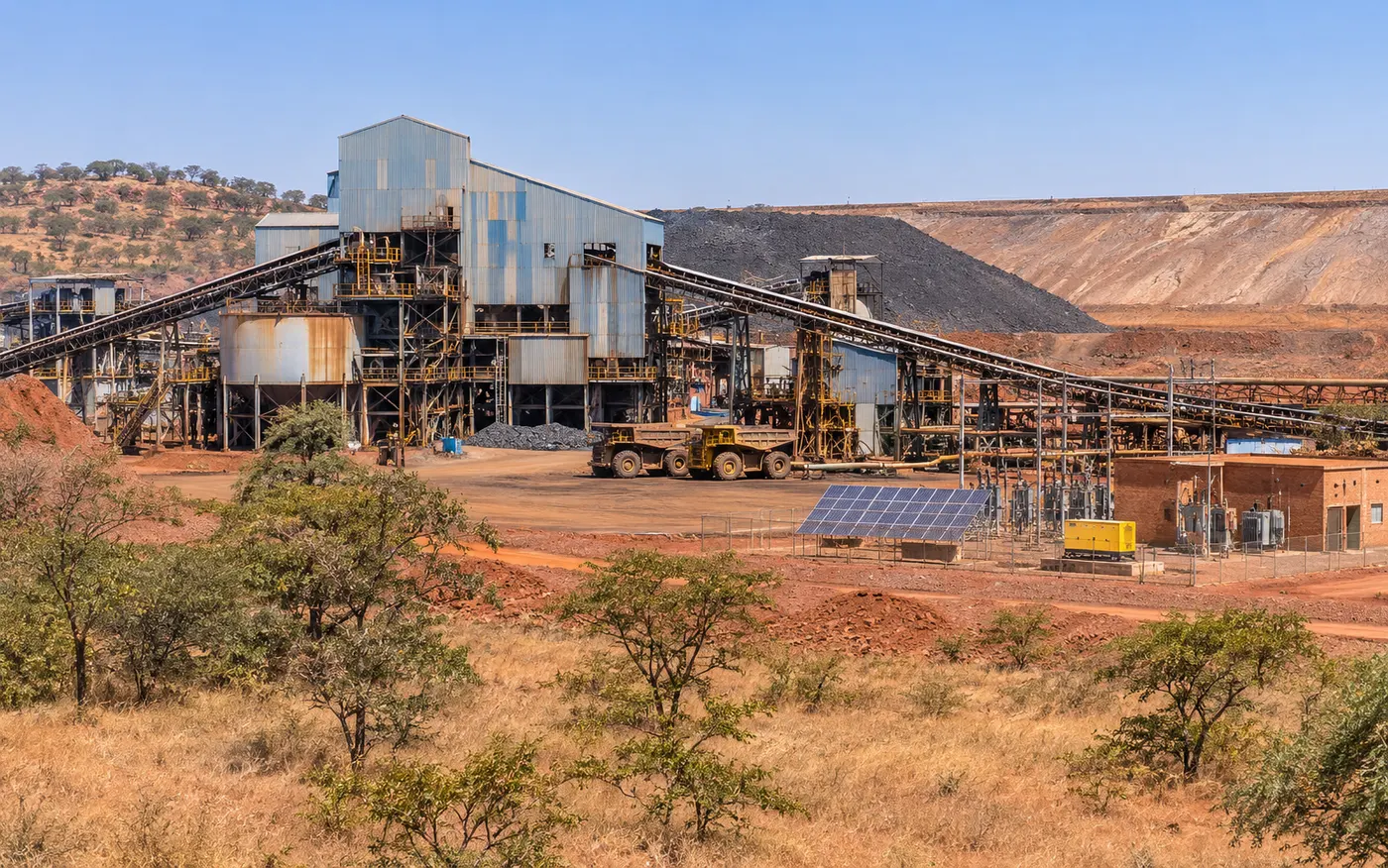
Take a smelter or processor that sells to a European customer. Its Scope 1 emissions come from fuel and reductants burned on site. Scope 1 means emissions from fuel you burn yourself, and a reductant is a material such as coke or charcoal that strips oxygen from ore and releases carbon dioxide. Its Scope 2 is mostly electricity, because smelting uses a great deal of it. Scope 2 means emissions from the electricity you buy. Reports on Zimbabwean ferrochrome put consumption at about 3,500 to 4,000 kilowatt-hours per tonne of product.
In its Scope 3, the screening would probably show purchased reductants and fluxes, mining and transport of ore, and the transport of product to the port and by sea. Category 11, the use of sold products, may be small if the product goes into steel. Category 10, processing of sold products, belongs to the customer. The exercise tells the smelter which categories to look at more closely and which to leave.
The central point is that for energy-heavy exports, electricity is often the largest cost. It also sets the Scope 2 figure that buyers with their own targets ask for. A smelter on grid power has a Scope 2 figure that depends on that year's generation mix. A smelter with its own renewable supply can lower that figure a great deal. The government has encouraged this through its captive power requirement for ferrochrome producers. The charge under the EU carbon border levy, called CBAM, is different, as explained below. Our article on powering a mine discusses the supply choices.
How this differs from CBAM reporting
The European Union's Carbon Border Adjustment Mechanism, or CBAM, applies to listed goods. They include iron and steel, aluminium, cement, fertilisers, electricity and hydrogen. As the system develops, it will also reach some downstream products. Importers must report the emissions inside these goods, and from 2026 they must pay for them. The rules define these embedded emissions narrowly. For iron and steel goods, including ferro-chromium, and for aluminium, only the direct emissions of the production process count. For cement and fertilisers, the indirect emissions from the electricity used count as well. Both are worked out by set methods. If importers cannot get verified data from the producer, they must use default values. The regulation sets these on the high side on purpose.
The differences from a Scope 3 inventory are important.
- CBAM asks about the product, not the company.
- It follows a fixed method set in EU regulations, not the flexible guidance of the Greenhouse Gas Protocol, which is the most widely used standard for measuring and reporting emissions.
- It has a money cost for the importer, who passes it back to the supplier.
A producer that can show verified emissions below the default value protects its price. Our CBAM guide explains the timetable and the data that buyers will ask for.
Getting supplier data, and giving it
A screening is the first step towards better data. For the material categories, you ask your own suppliers for primary data. That means the emissions of the product you actually buy, not an average. Suppliers answer on a simple standard form. It covers the quantity supplied, the production emissions per unit and the method used.
In the other direction, prepare a standard answer for your customers. It should have a short statement of your Scope 1 and 2 emissions, the product carbon footprint where requested, the boundary and the method. Preparing it once saves you from giving repeated and inconsistent answers to different buyers.
Prioritising effort and money
The order that works for most exporters is simple.
- Build the Scope 1 and 2 inventory first, because buyers ask for it first and because you can control it.
- Run the Scope 3 screening to rank the categories.
- Collect primary data for the top two or three.
- Calculate the product carbon footprint for your main export lines.
- Only then think about verification and public disclosure. Verification means an independent person checks that your figures are true and that you followed the method.
At each step the benefit is commercial. You keep a customer, protect a price or earn a place on the supplier list of a buyer with a decarbonisation target.
How AVEX GRID helps
- Scope 3 screening. We estimate the fifteen categories from your spend and quantity data and rank them for effort.
- Product carbon footprint and CBAM data. We calculate the emissions of your main export products using the method your buyers require.
- Power and emissions strategy. We model how solar, storage and other supply choices change your electricity emissions and cost.
What AVEX GRID can take off your hands
AVEX GRID is an engineer-led energy consultancy in Zimbabwe. We do the technical work that turns an energy investment into a plant that is licensed, connected, financed and performing, whether you are a local operator or an investor overseas.
We quote fixed prices after a free scoping call and reply the same working day.
Frequently asked questions
What is the difference between Scope 3 and CBAM data?
Scope 3 is a company-level inventory using flexible guidance. CBAM asks for the embedded emissions of specified products using a fixed method, and it carries a financial charge.
Do we need to measure all fifteen categories?
No. A screening ranks them, and detailed work goes to the few that are material.
How accurate is a screening?
It is approximate by design. Its purpose is to rank categories, not to give a final figure.
Can lower electricity emissions improve our position?
Yes. For energy-intensive products electricity is often the largest single contribution, and a lower-carbon supply reduces both the reported figure and the exposure to carbon costs.
Sources and notes
General information to help you plan. The rules that apply to your site are confirmed by AVEX GRID against the current gazetted text, ZERA and ZETDC as part of the work. The sources used are listed below.