
Powering data centres and telecom sites in Zimbabwe: uptime, batteries and cost
A data centre or telecom tower sells uptime. Every power choice, from batteries to generators to cooling, is judged by how many hours a year the service stays up.
In this article
Key points
- The availability target drives the design. A higher target needs more spare power and cooling. The Uptime Institute tiers are the common language.
- Cooling is the biggest overhead. Power usage effectiveness (PUE) averages about 1.55 across the industry, and newer sites reach 1.3 or better.
- The power chain is utility, UPS with batteries, then generator, with automatic transfer between levels and regular testing under load.
- GSMA studies found most off-grid and weak-grid towers in Africa run on diesel. Solar with lithium batteries can replace most of it.
- Redundancy that is never tested is a hope, not a design. Monitoring and testing make it real.
Digital services depend on stable power more than almost any other industry. A short break in a server room can corrupt a database and knock thousands of connections offline. A cell tower that loses power silences a whole community. In these facilities the electrical design puts continuity first and cost second. The clever engineering is in cutting cost without cutting continuity.
Availability as a design target
The Uptime Institute sorts data centres into four tiers. The tier depends on the redundancy built into their power and cooling. Redundancy means having spare equipment, such as a second generator or battery, so one failure does not stop the service.
A Tier I facility has a single path for power and cooling and no spare parts. Any failure or maintenance job interrupts the service. A Tier II facility adds spare components. A Tier III facility has more than one path, so it can be maintained without shutting down. This is called concurrent maintainability. A Tier IV facility is fault tolerant. A single failure in power or cooling does not interrupt the IT load.
Each step up in tier adds cost and complexity. So choose the tier from the cost of downtime to your customers, not from prestige.
The same logic works on a smaller scale, for a telecom switch room, a bank's server room or a regional hosting facility. First ask how much interruption the service can tolerate in a year. The answer decides how many generators, UPS units and independent feeds you need. A UPS is an uninterruptible power supply, a battery unit that keeps critical equipment running during a power cut.
The power chain
The classic power chain has three stages.
The utility feed is the main source. Where the grid allows, a second independent feed adds safety. In practice, though, utilities in this region often supply both feeds from the same upstream point. Next comes the UPS with batteries. It carries the load with no break at the moment of failure. It also cleans up the supply by filtering out sags and surges from the grid. Then comes a generator, with enough fuel on site for the longest outage the design allows for. It takes over once it has started and settled. Automatic transfer switches and distribution boards send power between the sources and feed the redundant paths to the equipment.
Designers use a short notation to describe redundancy. N is the capacity needed to carry the load. N+1 adds one spare unit, so any one unit can fail or be serviced. 2N duplicates the whole system. Choosing among them is a trade-off between cost, space and the effect of a failure.
Whichever you choose, test the batteries, generators and switches on a schedule. The most common cause of a failed backup is a part that has quietly worn out.
Cooling and power usage effectiveness
Servers turn almost all the electricity they use into heat. The cooling system exists to remove that heat. So the efficiency of a facility is measured by power usage effectiveness, or PUE. It is the total energy of the facility divided by the energy used by the IT equipment alone. A value of 1.0 would mean nothing is spent on cooling, lighting or losses.
The Uptime Institute's annual survey has put the industry average at about 1.55 to 1.58 in recent years. That figure has hardly moved. Many recent large builds do reach values near 1.3, and sometimes lower.
The measures that lower the number are mostly about managing air. Containment separates the hot and cold air streams. This stops the supply air mixing with the return air, and lets the cooling plant run at a higher supply temperature. Raising the set point, within the limits the equipment makers allow, reduces the work of the compressors. A compressor is a machine that squeezes air or gas, and it is the biggest power user in a cooling plant. A higher set point also gives more hours when free cooling is possible. Sealed floors and blanking panels stop air bypassing the equipment.
In a warm climate with good sun, an efficient cooling design has a large effect. Every kilowatt you save in cooling is a kilowatt that the UPS, the generator and the solar array do not have to supply.
Figures come from different studies, markets and years. Source: GSMA, Tower Power Africa
Telecom towers: batteries, solar and the diesel problem
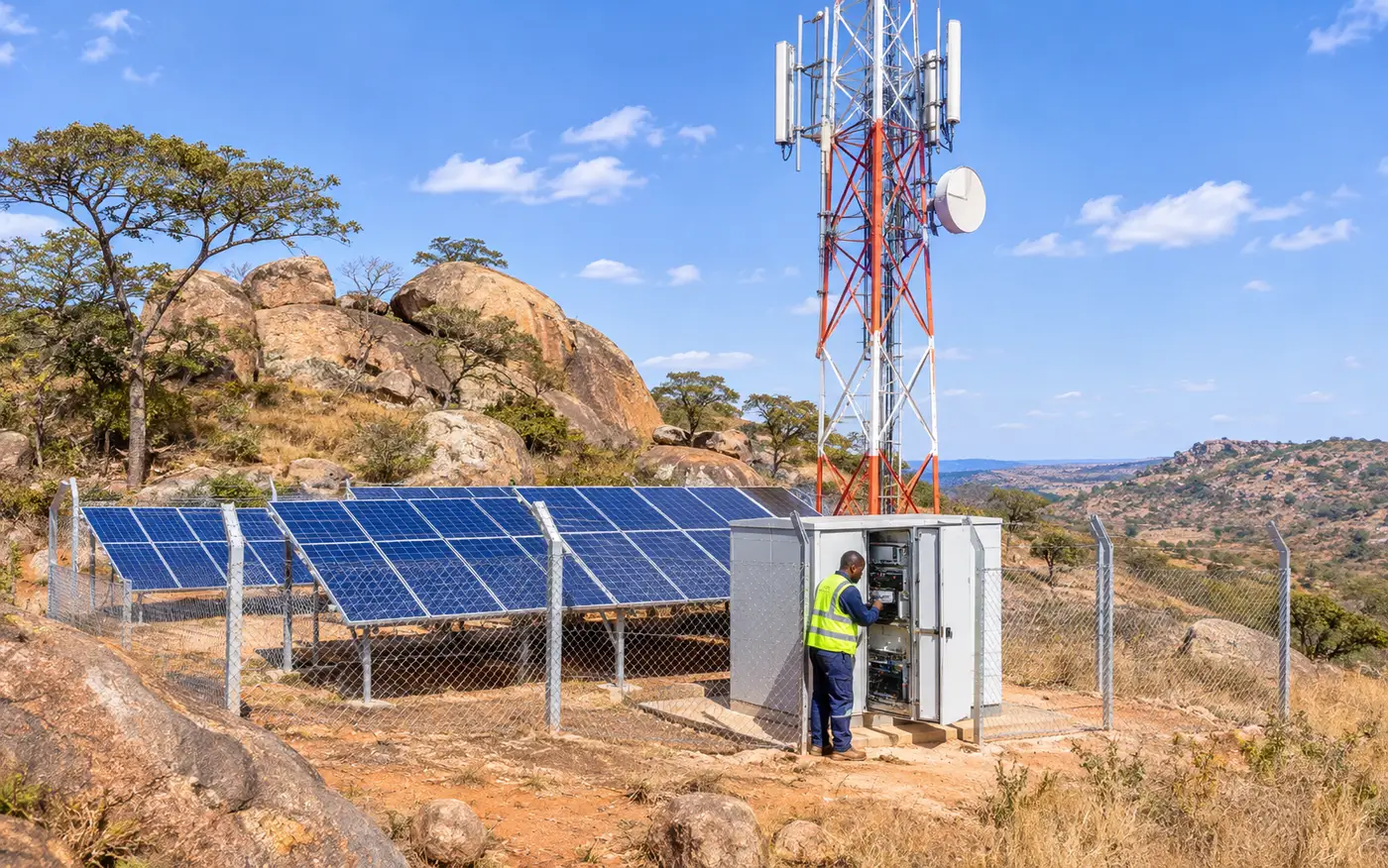
A telecom tower is a small facility. Its load is only a few kilowatts, yet it depends heavily on its supply. Many towers, especially in rural areas, are off-grid. Others sit on a grid so weak that they spend much of the day on generator power.
The GSMA, the body for mobile operators, has documented the results across Africa. In studies of Ghana and Nigeria, nearly 55% of off-grid sites were powered by diesel generators running around the clock. Later GSMA work found that in the first quarter of 2020 around 88% of off-grid and bad-grid tower sites still ran on diesel. In the Democratic Republic of Congo, about 75% of towers in off-grid and weak-grid areas were diesel powered. Diesel is expensive to buy and expensive to deliver to a remote site. It is also easy to steal and it pollutes. That is why operators have moved towards hybrid systems.
The standard modern design combines three parts: a photovoltaic (solar) array, a lithium-ion battery bank and a generator kept as backup. Lithium-ion is the most common type of rechargeable battery for solar systems. It is light and efficient and lasts for thousands of cycles. The solar array supplies the daytime load and charges the battery. The battery carries the night load. The generator starts only when the battery runs low after a run of poor weather.
At suitable sites this cuts the generator running hours by most of what they were. That means less fuel, fewer deliveries and less maintenance. Lithium batteries also handle deep daily cycling better than lead-acid batteries, and they are much smaller. That matters where the equipment shelter is small.
The design depends on the load of the radio equipment, the sun at the site and the number of cloudy days you allow for. Test it with an hourly simulation, not with rules of thumb. Our article on sizing solar plus battery explains the method.
Protecting the equipment and the people
Protection and monitoring turn redundancy on paper into availability in practice. Availability is the share of the time a system is ready to work.
A protection study confirms that a fault at one load clears locally, without taking the whole board down. Remote monitoring of battery voltage, temperature, generator state and fuel level lets operators step in before an outage. Thermal imaging of switchboards, connections and battery terminals finds hot spots that come before failures. Our article on thermal imaging explains what a survey finds. At remote sites, physical security matters as much as the electrical design. Strong enclosures and mountings reduce losses from theft.
How AVEX GRID helps
- Power architecture. We design the layers to your availability target and your budget, and we calculate the cost of each level of redundancy.
- Solar and battery for sites. We size hybrid systems for remote towers and server rooms and model the fuel saving on an hourly basis.
- Studies and surveys. We run load-flow, protection and thermal checks that show where a design is weak.
What AVEX GRID can take off your hands
AVEX GRID is an engineer-led energy consultancy in Zimbabwe. We do the technical work that turns an energy investment into a plant that is licensed, connected, financed and performing, whether you are a local operator or an investor overseas.
We quote fixed prices after a free scoping call and reply the same working day.
Frequently asked questions
What is PUE?
Power usage effectiveness: the total facility power divided by the power used by the IT equipment. A lower number means less energy goes to cooling and losses.
Can solar power a telecom tower?
Yes. With lithium batteries and a generator as backup, solar can supply most of the site energy and cut generator running hours substantially.
How long should batteries last through an outage?
The autonomy is set by the availability target. At a data centre it covers the time for the generator to start and stabilise. At a remote tower it covers the night and periods of poor weather.
What is the first step for an existing site?
A load measurement and a review of the single-line diagram and the test records.
Sources and notes
General information to help you plan. The rules that apply to your site are confirmed by AVEX GRID against the current gazetted text, ZERA and ZETDC as part of the work. The sources used are listed below.